Connecting practitioners and stakeholders with the Hub’s novel research is an important focus of our members. That’s why the Nature Connection project attended the 18th Biennale Conference on Communication and the Environment in Hobart. This provided a platform for the team to share their unique storytelling and gathering methods with environmental communicators from across Australia and the world.
Gathering nature connection stories with the Pod
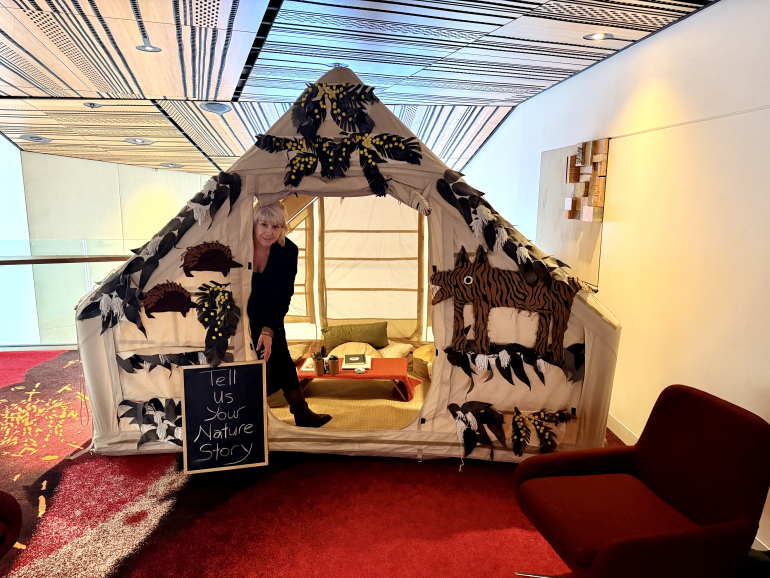
One of the project’s techniques for gathering nature connection stories is the Nature Storytelling pod, pictured above. The project team deployed the Pod at the conference and were able to capture 11 new stories from attendees. It was also an interactive way to engage practitioners with the project’s unique qualitative data gathering technique. This led to insightful discussions and suggestions that can be iteratively added to the project to strengthen its impact.
Sharing insights from preliminary storytelling analysis
Pauline Marsh also presented the project’s analysis of the first 100 stories, identifying three key themes that have been generated through the textual analysis. These include:
Nature connectedness is multifaceted
For example, "With deer hunting it’s nice, in an existential way, to feel small and unimportant. It’s similar to when you go on a bushwalk and you finally get to the top of a mountain and look out over everything and you know that your presence does not make a difference at all, you’re completely unimportant in the best way." (Rob, adventure talk)
Nature/Human relationships are pedagogical
The teaching and learning is cyclical: for example, "The Franklin taught me about nature …/How recklessly we disturb its exquisite balances and yet how quickly we become irrelevant/…The Franklin taught me about myself …/How I am small and insignificant to many/Loved and important to a few/And pretty much everything to me." (Karen, nature poetry)
People hold deep, somewhat conflicted connections to nature
Sometimes romantic, sometimes enraged: for example, "I was awed by the gothic beauty of the rugged landscape, romanced by the lush ancient forests and enamoured by the pristine beaches. It made me want to protect it – fiercely. I wanted to elicit an emotional response to the plight of the wilderness by drawing parallels to our own experience of suffering." (Fiona, autobiography)
The findings show the depth of experiences of nature connectedness. They highlight how we feel nature in our bones - we inhabit it, know it, sense it. Humanity, the storytellers suggest, exists in a complex relation to non-human nature. The stories confirm the idea of three elements of nature connectedness – mind, body, heart – but they also highlight the intricacies, overlaps and tensions between these elements.
‘Telling the Whole Story’ Panel Discussion
The project also presented the project’s work in more depth with a panel and workshop session. The sessions brought together:
- Emily Flies, Project lead, University of Tasmania
- Jen Sharman, Community Engagement Manager, University of Tasmania
- Catherine Atkinson, National Environmental Science Program, Australian Government Environment Department
- Affaf Wafa, Nature Connection Project social media manager
- Sa Ta Ray Hlaing, local Tasmanian story contributor
Emily began with an overview of the project, its objectives, the co-design process and next steps. Meanwhile, the panellists provided thoughtful and tangible insights into their different lenses of the work. The presentation ended with a nature storytelling workshop, where Jen guided participants to connect with their own experiences in nature to create a story. The session also handed participants tools to gather nature connection stories in their own communities for the project and/or for their own work, including the Nature Storytelling Guide.
Access the Nature Storytelling Guide
Creating tools for practitioners to quantify and qualify nature connection
By engaging with environmental communication professionals in these spaces, the research team were able to:
- gather more nature connection stories
- create pathways for practitioners to gather stories themselves
- engage attendees with the Hub’s novel research techniques.
The team will continue to gather, analyse and translate this important qualitative and quantitative data to build an in-depth national snapshot of nature connection in Australia. This co-designed work will act as a tool for policymakers and stakeholders to better understand and implement Australia’s connection to nature in their work.

