
Every time it rains in an Australian coastal city such as Sydney or Melbourne, a hidden cargo of plastic fragments flows through stormwater drains, and heads into our waterways and the ocean.
Researchers from the Sustainable Communities and Waste Hub have now mapped exactly what’s washing off our streets into the sea. They have discovered that commercial areas are microplastic hotspots.
The problem: stormwater carries plastic to sea
The main source carrying plastic into rivers, estuaries and the ocean is urban stormwater runoff. This stormwater is mainly rainwater that runs off roads and buildings, where it can’t be absorbed, into the extensive drainage system of gutters, drains and underground pipes, designed to prevent flooding in our cities.
As stormwater travels through these pipes, it collects organic materials like leaves and twigs – but it also picks up discarded waste and chemicals, including plastic waste and fragments.
Most stormwater is barely filtered before it reaches creeks, rivers and the ocean. Constructed devices like gross pollutant traps and litter booms capture some of the larger waste; the rest flows through waterways to the sea – including a substantial load of microplastics.
Once there, these particles persist for decades, potentially harming ecosystems and entering food chains.
The investigation: tracking sources
Until now, nobody had systematically measured what types of plastics are mobilised from different urban land uses.
In 2025, researchers from UNSW Sydney partnered with environmental engineering firm Ocean Protect to sample stormwater from industrial sites, commercial carparks and residential streets across Sydney.
They analysed plastics captured by the firm’s specialised stormwater filtration systems before they entered the public drainage network.
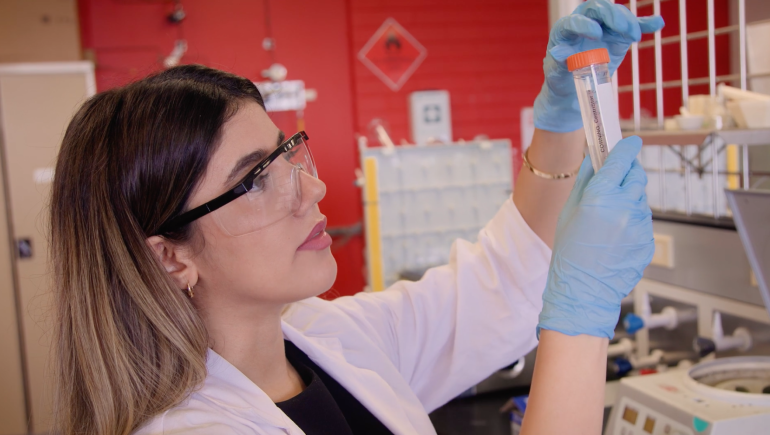
The team, led by Professor Veena Sahajwalla and Dr Sanjith Udayakumar, with doctoral researchers Sofia Payel and Asiyeh Kheradmand, investigated the composition of the different microplastics found, and the quantities from each site type.
“Stormwater drains carry more than just water,” Dr Udayakumar says. “Hidden within this runoff are residues, leaves, sediments, a lot of plastics, and other pollutants that enter our main waterways.”
Commercial areas top the pollution league
Commercial catchments generate the highest loads of both macroplastics and microplastics. Shopping centres, office complexes and busy carparks produce more plastic pollution than other land uses, driven by intensive human activity, vehicle movement and packaging waste.
Industrial sites contributed large plastic items that fragment into microplastics over time, while residential areas produced less total plastic - but a greater proportion of fine, highly mobile particles under 500 micrometres.
VIDEO: Dr Sanjith Udayakumar, Asiyeh Kheradmand and Sofia Payel analyse microplastics in the lab
What plastics were found
The team collected samples from specialised filtration bags used in stormwater drains and processed these, drying the samples and removing organic matter, using zinc chloride solution to perform density separation, and then filtering the samples across multiple size fractions.
“We have the denser particles in the bottom, and we have the lighter particles, which contains plastic, on top,” says PhD candidate Asiyeh Kheradmand. “After that, we do the filtration.”
The team uses optical microscopy to visually identify particles, followed by FTIR spectroscopy to confirm polymer types by comparing spectral fingerprints against reference libraries.
The most common plastics found were polyethylene, polypropylene and polyester – the everyday plastics found in packaging, textiles and consumer products.
Across all catchments, most particles measured 1 to 5 millimetres; this shows fragmentation was already advanced before this plastic waste reached stormwater.
Fine particles under 500 micrometres were more common in residential roads and industrial sites, while larger debris concentrated in industrial and commercial zones.
**
Read the full report here
Read the Fact Sheet here
