
The Department of Climate Change, Energy, the Environment, and Water has recently unveiled Australia's Circular Economy Framework, designed to guide the nation’s transition to a circular economy. The framework sets an ambitious national goal: to double Australia's circularity by 2035. Within the same timeframe, it also targets a 10% reduction in per-capita material footprint, a 30% increase in material productivity, and an 80% resource recovery rate. The CSIRO will support this effort by monitoring material flows and tracking progress toward circularity.
The framework identifies four key sectors crucial to achieving Australia’s circular economy goals: manufacturing, the built environment, agriculture and food, and mining. CSIRO has highlighted how adopting circular practices can bolster Australia’s competitive and comparative advantages, leverage existing strengths, and address improvement areas.
In the short term, the circular economy presents economically attractive opportunities, particularly in revitalising Australia's manufacturing sector. This aligns with the objectives of the National Reconstruction Fund, a $15 billion investment by the Australian government to diversify and transform the country’s industry and economy. Policies like Extended Producer Responsibility and the Right to Repair can ensure consumer goods have longer lifespans while facilitating the recovery of materials at the end of their lifecycle.
In the built environment, the circular economy can address the housing crisis by raising the standard of new and refurbished buildings. Australia can create low-carbon, circular structures through sustainable design and material choices. Investing in a local prefabricated building industry offers additional benefits, such as faster construction timelines, reduced waste, and enhanced environmental performance. Australia can also lower costs and avoid import delays by manufacturing building components locally.
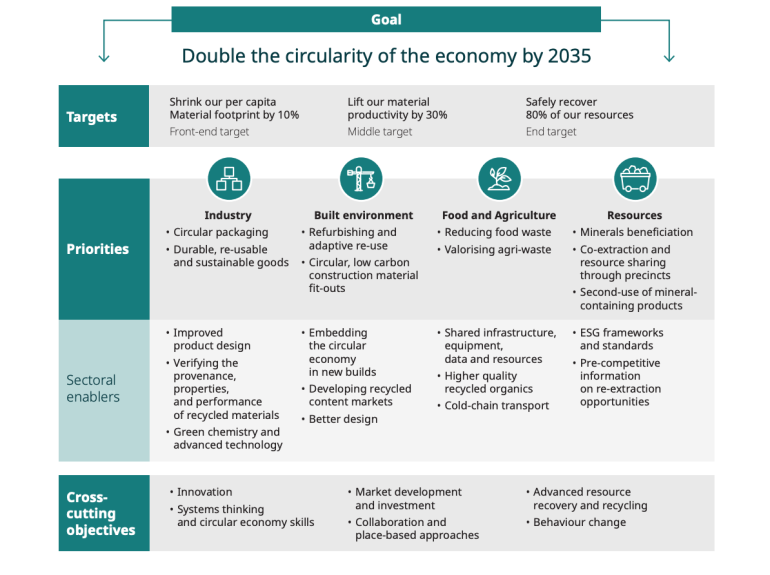
The agriculture and food sectors present opportunities to repurpose agricultural by-products that would otherwise become waste, reduce plastic use in farming, and add value to primary production.
Similarly, the mining sector, positioned at the forefront of global supply chains, can play a pivotal role by contributing to domestic value-adding and supporting material passports. These passports provide essential information about materials during their initial use, enabling better resource recovery and recycling at the end of life. The sector can also extract value from mine tailings and engage in innovative recycling practices, shifting from a material extraction model to one focused on material provision.
The energy transition to a renewable, low-carbon system intersects significantly with circular economy principles. Australia can support its broader greenhouse gas reduction efforts and dematerialise economic activity by emphasising the reuse and recycling of energy infrastructure components at the end of their life.
The Circular Economy Framework offers guidance to businesses and supports existing circular economy initiatives across large corporations and SMEs. It also provides a roadmap for policymakers, delivering the economic and regulatory signals necessary to advance the circular economy transition.
With the release of this framework, Australia is now well-positioned to implement its ambitious goals and accelerate the shift toward a sustainable, circular economy.
Written by IP5: Waste Impact Management co-lead Heinz Schandl
Originally posted on LinkedIn
See Heinz's CSIRO profile
