
Hub researcher experiments demonstrate that a widely used plastic for drink and food containers more easily breaks down into microplastics under common household usage and from environmental exposure than previously thought.
This study demonstrates that low-temperature, solid-state thermal aging under dry atmospheric-oxygen conditions fundamentally alters the structural integrity of polypropylene (PP), preconditioning the material for mechanically driven fragmentation and subsequent microplastic release.
Prolonged thermal exposure induces progressive molecular-level weakening and surface breakdown, and follows earlier Hub research into PP plastic bottles that found baby bottles released more microplastics under thermal stress (heating), whereas surface and mechanical stresses predominated in water bottles.
Polypropylene is blow-molded into bottles for foods, shampoos, and other household liquids, and it is also injection-molded into many products, including appliance housings, dishwasher-safe food containers, toys, automobile battery casings, outdoor furniture and fibres used for many types of domestic textiles and carpets.
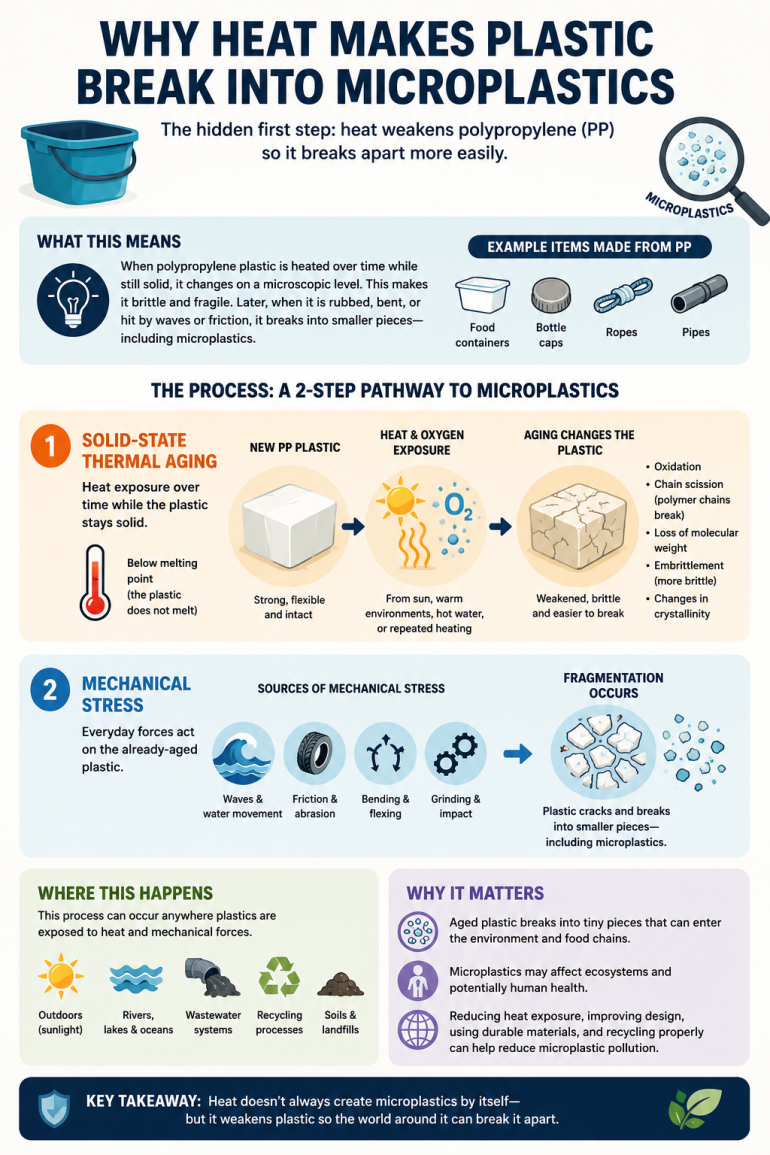
This infographic demonstrates the process of plastic breakdown in relation to this study:
The study was done as part of the Hub's Understanding Microplastics research stream under the Impact Priority 2 Plastic and Waste Materials Program.
Supported with funding from the Australian Government under the National Environmental Science Program, this new study just published in Nature Briefing:
- Emphasises the importance of incorporating dry, sub-melting thermal aging and moderate mechanical stress into environmental risk assessments, particularly for indoor and end-use scenarios such as repeated dishwasher cycles, microwave heating, or other high-temperature consumer exposures.
- Demonstrates that solid‑state thermal aging acts as a critical preconditioning step that enhances mechanically driven fragmentation, even under limited oxidation, facilitating enhanced microplastic release. thermal aging-induced embrittlement rather than extensive oxidation governs the observed degradation behavior
- Shows thermal preconditioning exerts a stronger influence on microplastic release than agitation intensity, while mechanical stress functions as a secondary but necessary driver that propagates cracks and facilitates fragment detachment once sufficient aging-induced weakening has occurred.
- Shows that PP products may contribute to progressive release of secondary microplastics to the environment over decades or even centuries, along with residual additives and plasticizers.
- Shows that their small size, large surface area, and hydrophobic nature make microplastics not only persistent pollutants themselves but also efficient carriers that readily absorb and transport organic contaminants through the environment.
- Shows microplastics have been found in the food chain, from zooplankton to birds, seafood, and different parts of the human body, e.g., blood, heart, bone marrow, and even placenta, through ingestion and inhalation.
This latest research was also supported under the University International Postgraduate Award (UIPA) program of UNSW Sydney, Australia.
The authors also acknowledge the facilities and the scientific and technical assistance of Microscopy Australia at the Electron Microscope Unit (EMU), and the Spectroscopy Laboratory, within the Mark Wainwright Analytical Center (MWAC) at UNSW Sydney, Australia.
In earlier, related work, Hub researchers have developed a practical framework toolkit to improve how micro and nanoplastics are detected and measured in the environment. The work provides clearer guidance for scientists and stronger evidence for policy and regulation.
Microplastics and nanoplastics are now found in water, soil and air. Yet measuring them accurately remains a major scientific challenge.
Differences in laboratory methods can produce inconsistent results, making it difficult to compare studies or assess risk with confidence.
The toolkit reviews and evaluates a wide range of laboratory techniques used to detect and characterise micro and nanoplastics. It examines:
- Mass-based methods that identify plastic types through chemical signatures
- Microscopy and spectroscopy approaches that count and classify particles
- Separation techniques that isolate particles by size and density
By comparing strengths and limitations, the research shows how combining methods can produce more reliable and comprehensive data.
