A new report has been published which summarises several years of research into ideas and strategies on building a more nature-connected Australia, and lists three key recommendations to help turn this goal into reality:
• making time outdoors part of daily life
• widening access to green space and
• placing care for Country at the heart of decisions.
Co-authors Steph Brake, Kate Sollis, Kanchana Wiset and Emily Flies, all from the School of Geography, Planning and Spatial Sciences at the University of Tasmania, were supported by the Sustainable Communities and Waste Hub’s Nature Connection Project.
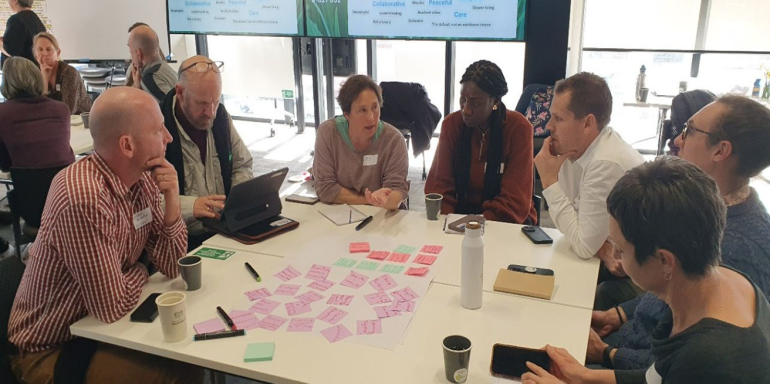
Their report, ‘Achieving a Nature Connected Future: science, strategies and stories’ captures a two-day workshop in Hobart, where more than 60 researchers, policymakers, practitioners and community leaders shared evidence and ideas.
The workshop was hosted by the Hub’s Nature Connection Project team, with the Department of Climate Change, Energy, the Environment and Water, the University of Tasmania and the Healthy Environments and Lives National Research Network.
The report brings research together with participants’ experiences and proposals.
The authors led a national survey of more than 4,000 Australians, which found strong links between nature connection, life satisfaction and quality of life. They also found that people who feel more connected to nature were more likely to take part in conservation advocacy and make environmentally conscious choices.
However, access to nature was uneven across respondents. Cost, health, geography, time pressures and housing insecurity can all make it harder to spend time in nature. Participants also pointed to short-term funding, government silos and gaps in political support as barriers to lasting action.
The report authors outline a vision of nature as part of ordinary life: children learning outdoors, walkable neighbourhoods with accessible green spaces, and councils building nature into planning, health and community programs.
The report calls for long-term funding, better ways to track progress, and stronger collaboration across government, health, education and community groups.
First Nations leadership and knowledge, the report says, must guide this work. Its central message is that nature connection needs to be built into the systems and places people rely on every day, so its benefits are open to all.
