

Hub research has found that buildings may be an overlooked source of environmental microplastic pollution.
The study examined what happens to plastic building materials when they are exposed to sunlight over long periods of time, with a particular focus on how ultraviolet (UV) radiation gradually breaks them down and contributes to the formation of microplastics.
The study is titled “Breaking down building plastics: Exploring UV-induced degradation pathway and its impact on structural integrity and microplastics formation” and was published in Materials Today Communications.
The authors investigated how common plastics used in buildings deteriorate when repeatedly exposed to UV radiation from sunlight.
While plastics are valued in the construction industry because they are lightweight, durable and inexpensive, they are constantly subjected to weathering throughout their service life.
The research shows that UV radiation initiates chemical changes within the plastic structure, gradually weakening the material and making it more brittle. Over time, these changes can reduce the material's mechanical strength and structural reliability.
A key finding is that degradation does not occur all at once. Instead, UV exposure triggers a sequence of chemical reactions that progressively damage the polymer chains that give plastics their strength and flexibility.
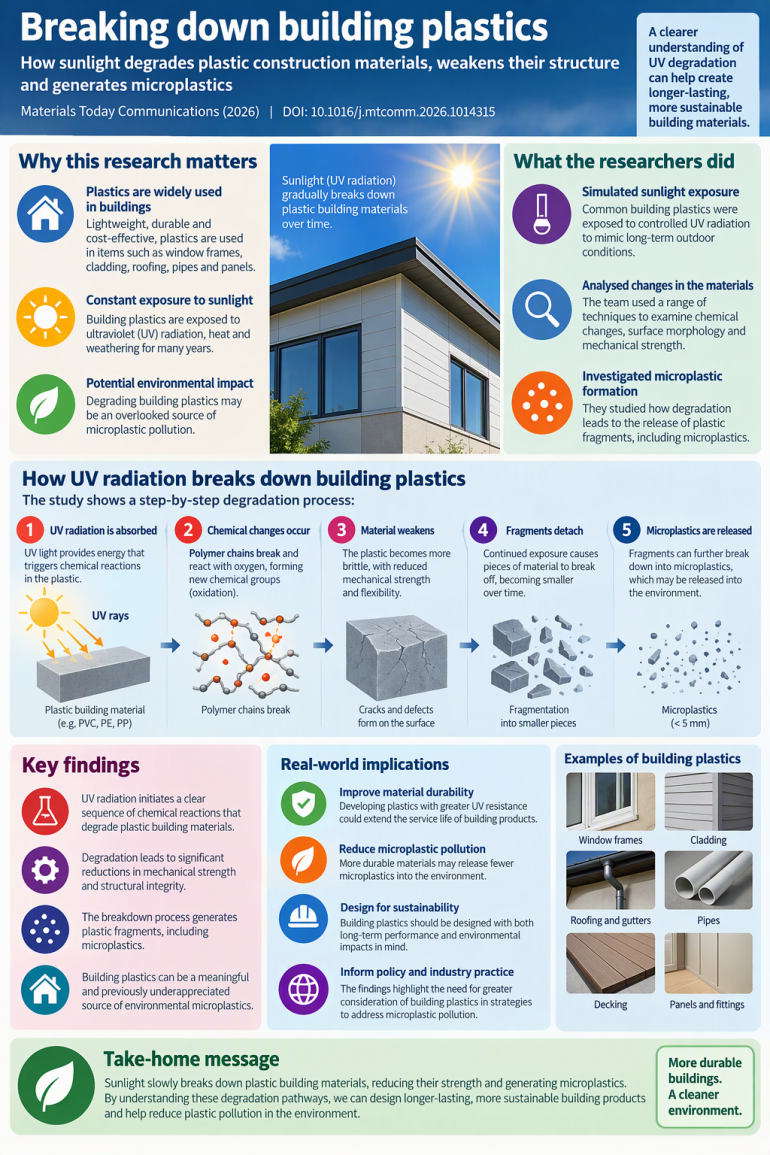
As these chains break apart, the surface develops cracks and defects. Continued exposure causes pieces of material to detach, creating increasingly smaller fragments that can eventually become microplastics.
The study highlights the fact that buildings may be an overlooked source of environmental microplastic pollution.
Most discussions about microplastics focus on packaging, textiles or tyre wear, but exterior building products made from plastics are also exposed to intense sunlight and weathering for decades.
As they age and degrade, they can release microscopic plastic particles into the surrounding environment.
In practical terms, the research identifies a direct link between material ageing and environmental impact.
The same degradation processes that reduce the service life of plastic construction materials are also responsible for generating microplastics.
This means that designing plastics with greater UV resistance could provide two benefits simultaneously: extending the lifespan of building products and reducing microplastic generation.
Overall, the paper argues that understanding UV-induced degradation is important not only for maintaining the durability and safety of plastic building materials, but also for addressing the emerging environmental challenge of microplastic pollution.
It suggests that future building products should be designed with both long-term performance and environmental consequences in mind.
The study shows that improving the UV resistance of building plastics could help buildings last longer while also reducing a potentially significant source of microplastic pollution.
The study was done as part of the Hub's Understanding Microplastics research stream under the Impact Priority 2 Plastic and Waste Materials Program, supported with funding from the Australian Government under the National Environmental Science Program.
