Regional and remote communities face distinct barriers to recycling and waste recovery. Distance from markets, limited infrastructure and high transport costs can make conventional recycling technologies unsuitable or economically unviable. At the same time, many regional Aboriginal communities experience housing and environmental health challenges that require durable, safe and locally appropriate material solutions. Addressing plastic and waste materials in these contexts demands technologies that are fit for purpose and developed in partnership with communities.
Locally relevant recycling applications
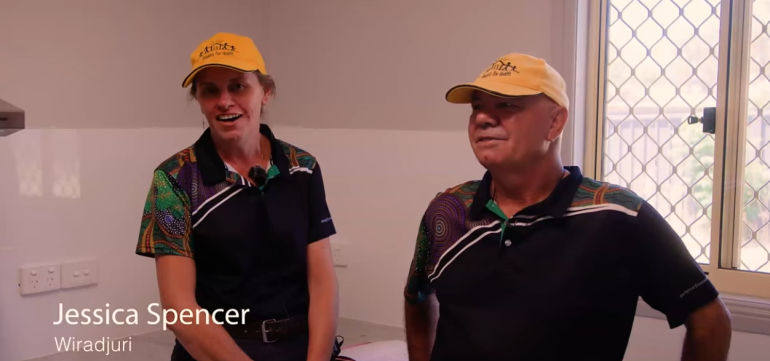
Under the Finding fit-for-purpose technological recycling solutions for regional and remote communities across Australia project, the Hub worked in Wellington in Western New South Wales to explore locally relevant recycling applications. The project collaborated with Health Protection NSW’s Environmental Health Unit and the Wellington Local Aboriginal Land Council. Through involvement in regional Aboriginal housing and community health initiatives, partners connected the research team with local houses in need of new flooring. The research team conducted a pilot experiment installing green ceramic tiles, remanufactured from waste, inside several homes.
From the lab to community piloting
The collaboration enabled the real-world piloting of remanufactured flooring solutions in regional Aboriginal housing, moving beyond laboratory research into applied community testing. By embedding the research within existing housing and community health initiatives, the project strengthened trust, improved access to pilot sites and ensured that recycling technologies were evaluated in partnership with local stakeholders. This has advanced practical pathways for deploying recycled materials in regional housing contexts. Local tradespeople and stakeholders were involved in installation and testing activities, enabling knowledge transfer on recycled material applications and supporting future adoption of sustainable building materials within regional communities. The successful case study was highlighted by Hub Leader Professor Veena Sahajwalla AO in her National Press Club address, demonstrating its national relevance as a model for regional recycling innovation.
Partnership model for utilising remanufactured products
The Wellington pilot demonstrates how technological recycling innovation can be co-designed and co-developed with regional communities to deliver locally appropriate outcomes. The partnership model with Aboriginal land councils, health authorities and housing organisations provides a transferable framework for other remote and regional locations. By linking circular economy innovation with housing quality and environmental health, the project contributes to more equitable access to sustainable materials solutions.

