Managing hazardous waste and complex recycled materials is one of the most pressing challenges for Australia’s circular economy. To support safe recycling and reuse, the Sustainable Communities and Waste (SCAW) Hub’s Impact Priority 3 (IP3): Hazardous Waste and Pollutants has released nine new factsheets.
Co-designed with the Department of Climate Change, Energy, the Environment and Water (DCCEEW) and state environment agencies, the factsheets transform scientific research into accessible, practical tools for policy, regulation and industry practice. This is part of the Hub’s wider objective to deliver fit-for-purpose outputs that ensure our science is applied and generates positive impact.
Understanding the Challenge
Keywords: chemical characterisation, emerging risks, complex waste
IP3’s research commits to characterising chemicals within waste streams and recovered resources. By doing so, the research helps stakeholders assess the risks of reusing complex materials such as plastics, tyres and rubber crumb. This focus aligns with the national need to recover resources as part of the transition to a circular economy without compromising environmental or human health.
Factsheets 16A–C introduce IP3’s overall research strategy, explain how chemicals are assessed in different waste types and outline frameworks for decision-making in hazardous waste management.
Factsheet - Overview: Advancing the safe management of chemicals in the circular economy (Aug 2025)
Factsheet - Building capacity to address gaps in chemical risk assessments (Aug 2025)
Pathways to Safe Reuse
Keywords: risk assessment, safe recycling, circular economy
The factsheets highlight how science can inform the safe reuse of recovered materials. Case studies, including end-of-life tyres and recycled rubber crumb, illustrate the pathways and challenges in ensuring materials can be repurposed responsibly.
Factsheets 16D–G focus on chemical risk assessment approaches, describing methods to evaluate health and environmental hazards. They demonstrate how evidence-based frameworks can guide regulators, industries and communities in determining safe thresholds for recycling and reuse.
Factsheet - The path to waste chemical risk assessment (Aug 2025)
Factsheet - Method development for assessment of chemicals in complex waste materials (Aug 2025)
Factsheet - Co-designing research priorities for management of waste chemicals (Aug 2025)
Supporting Policy and Practice
Keywords: evidence for decision-makers, regulation, co-design
Strong partnerships between researchers, government and industry are central to IP3’s impact. The project ensures research is practical, relevant and fit-for-purpose by co-designing outputs with end users.
Factsheets 18A–B explore how national and state-level regulators can use IP3’s findings to shape safer waste management policy. They show how consistent chemical assessment approaches can provide a stronger basis for regulation and enable more efficient recycling systems across Australia.
Pathway to Impact
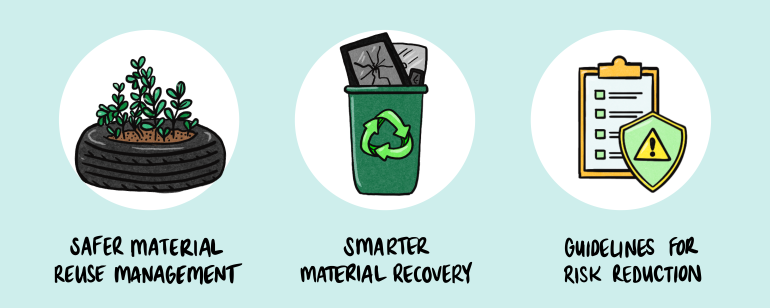
The Hazardous Waste and Pollutants research project is enabling:
- Clearer, evidence-based decisions for regulators and industry.
- Practical tools to evaluate and manage risks from hazardous waste.
- National consistency in safe recycling approaches.
- Progress towards a circular economy that safeguards health and the environment.
Together, these factsheets bridge the gap between research and real-world action, supporting Australia’s waste policy targets and helping to build a safer, more sustainable future.
